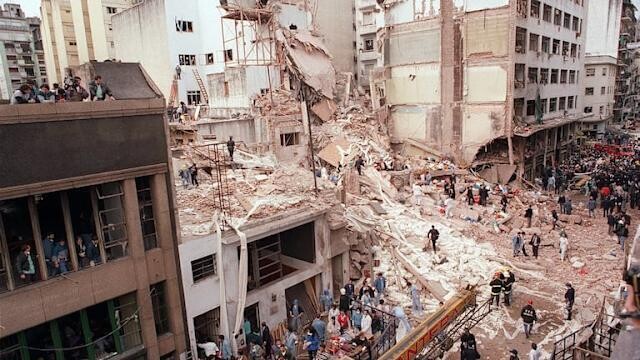
A source close to the investigation indicated that these same dissidents were “the first to warn Argentina, days before the attack, that the responsibility lay with the Iranian side,” a fact that adds additional weight to their statements within the framework of the evidence handled by the AMIA Federal Prosecutor's Office. The AMIA case has been under investigation for decades and has gone through several procedural milestones, including Judge Rafecas's decision to annul a trial in absentia against ten accused, including former Iranian government officials and members of Hezbollah, for their alleged involvement in the intellectual and material authorship of the terrorist attack. This measure was confirmed by higher judicial instances and supported by legislation that permits this type of criminal process when the accused remain fugitives from Argentine justice. According to the investigation consolidated by the AMIA Federal Prosecutor's Unit, the decision to carry out the attack was reportedly made on August 14, 1993, in the Iranian city of Mashhad, during a meeting of the regime's so-called “Special Affairs Committee,” with the participation of high-ranking officials of the Iranian government, including then-President Rafsanjani, Foreign Minister Velayati, Information Minister Fallahijan —all currently accused in the case— and Supreme Leader Ali Khamenei, who is said to have given the executive order that authorized the terrorist operation. The contribution of these testimonies comes at a time when the Argentine justice system is seeking to consolidate the file with evidence that can solidly support the elevation of the accused to trial in absentia, an exceptional mechanism that seeks to make criminal prosecution effective in the face of the impossibility of having the physical presence of the accused, many of whom have international arrest warrants in effect for decades. The participation of Iranian dissidents residing in Europe, historically linked to the resistance against the ayatollahs' regime, adds a new dimension to the case by providing personal accounts and internal knowledge about the functioning of Iran's state apparatus in the years leading up to the attack, something that the Prosecutor's Office and the federal court will evaluate carefully in the coming months to verify its coherence with the rest of the accumulated evidence. The progress of this judicial process occurs in parallel with other developments related to the AMIA case, including the ratification by Argentine courts of the new legislation that allows for trial in absentia, as well as the maintenance of extensive international extradition requests against the accused who remain outside the country, mainly in Iran and countries without extradition agreements with Argentina. The incorporation of these testimonies from Iranian exiles not only strengthens the search for justice for the victims and their relatives—who have waited more than three decades for a comprehensive judicial resolution—but also highlights the complexity of a case in which aspects of international politics, global terrorism, and human rights converge. Buenos Aires, December 18, 2025 - Total News Agency - TNA - The judicial investigation into the terrorist attack against the Argentine Israeli Mutual Association (AMIA), which on July 18, 1994, left 85 dead and hundreds injured, has added a chapter of high probative value after the testimony of four Iranian dissidents who provided fundamental data on the planning of the attack, in a process that could strengthen the next phase of the trial in absentia being instructed by Federal Judge Daniel Rafecas. After months of diplomatic efforts, the prosecution in charge of the case, led by Sebastián Basso, managed to interview the four witnesses in France, all members of the National Council of Resistance of Iran (NCRI), an opposition organization to the ayatollahs' regime with a historical presence in Iranian resistance from exile. Some have even been the subject of fatwas ordering their assassination and have suffered persecution, imprisonment, and attacks on relatives within the framework of decades of political confrontation with Tehran. According to judicial sources, the witnesses testified not only as such, but also as experts, since before their exile they would have had direct contact with regime authorities and access to first-hand information about the context and prior planning of the 1994 attack. The testimonies were physically taken in a locality on the outskirts of Paris, under strict cooperation with French justice and in accordance with its procedural rules, with the support of a team of specialized translators due to the absence of direct Persian-Spanish interpreters. The identities of the four dissidents are kept under guard for security reasons, in a context in which several of them face direct threats from the Iranian regime.